
Know About Launch of First Planetary Defence System
NASA has put forth a program to test out its defense methods called the Double Asteroid Redirection Test code name DART... Now Lets take a look how its gonna launch and probably when...

As of now you must have heard about Chicxulub crater in Yucatán Peninsula in Mexico caused by an asteroid measuring at least 10 Km, Which caused worldwide extinction of dinosaurs.
Near-Earth object (NEO) is any small Solar System body whose orbit brings it into proximity with Earth including Asteroids, Meteors, and Comets. Small asteroids, nearly 20 meters in diameter can cause significant damage to the local environment and human populations. Where as Larger asteroids penetrate the atmosphere to the surface of the Earth, producing craters if they impact a continent or tsunamis if they impact large water bodies. Near earth objects have generated increased interest since the 1980s because of greater awareness of this potential danger.
And since then planetary scientist are studying the near earth objects, And have found over 25,000 known near earth objects which poses a threat to humanity. It’s imperative that we have some sort of defense system against them just in case.
And here comes NASA’s defense program called the Double Asteroid Redirection Test, code name DART. The DART mission is in Phase C, led by APL and managed under NASA’s Solar System Exploration Program at Marshall Space Flight Center for NASA’s Planetary Defense Coordination Office and the Science Mission Directorate’s Planetary Science Division at NASA Headquarters in Washington, DC.
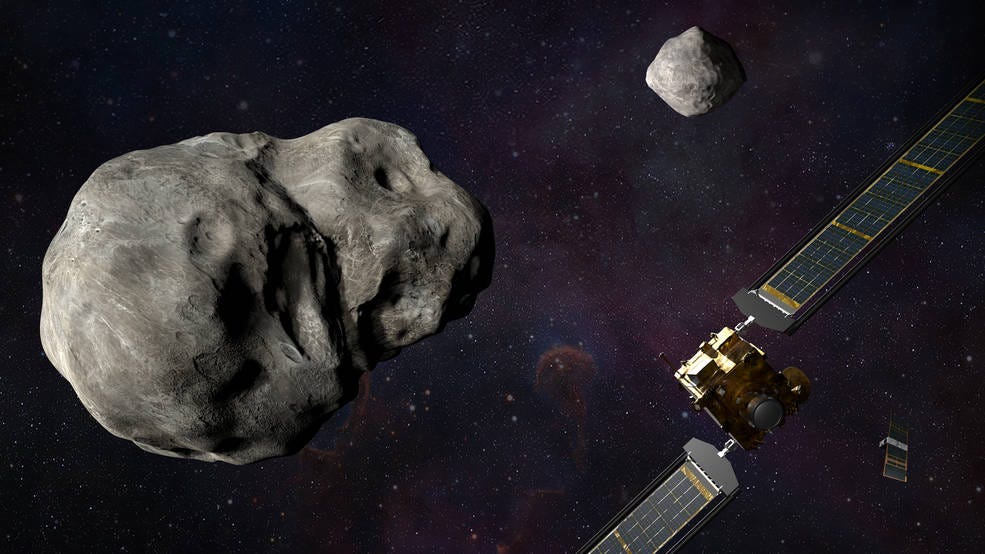
NASA seeks to test and validate a method to protect Earth in case of an asteroid impact threat. The mission aims to shift an asteroid's orbit through kinetic impact -specifically, by impacting a spacecraft into the smaller member of the binary asteroid system Didymos to change its orbital speed. A binary asteroid is a system of two asteroids orbiting their common barycenter. The Didymos primary body is approximately 780 meters across, Whereas it’s secondary body (or “moonlet”) is about 160-meters in size.
How will DART achieve this goal?
Once launched, DART will deploy Roll Out Solar Arrays (ROSA) to provide the solar power needed for DART’s electric propulsion system. By utilizing electric propulsion, DART could benefit from significant flexibility to the mission timeline while demonstrating the next generation of ion engine technology, with applications to potential future NASA missions. After DART spacecraft will reach near the asteroid Didymos, It will achieve the kinetic impact deflection by deliberately crashing itself into the moonlet at a speed of approximately 6.6 km/s, with the aid of an onboard camera (named DRACO) and sophisticated autonomous navigation software. The collision will change the speed of the moonlet in its orbit around the main body by a fraction of one percent, but this will change the orbital period of the moonlet by several minutes - enough to be observed and measured using telescopes on Earth.
When will DART be launched?
The DART spacecraft launch window begins November 24, 2021. DART will launch aboard a SpaceX Falcon 9 rocket from Vandenberg Air Force Base, California. After separation from the launch vehicle and over a year of cruise it will intercept Didymos’ moonlet in late September 2022, when the Didymos system is within 11 million kilometers of Earth, enabling observations by ground-based telescopes and planetary radar to measure the change in momentum imparted to the moonlet.